(1.9.1898 – 20.10.1966)

“There will always be another opportunity, another friendship, another love, a new strength.” This optimism was the sustaining conviction that enabled the Prilep-born writer, journalist and public figure Dimitar Talev to overcome the dramatic turns of his fate.
His life began in Bulgarian lands still under Ottoman rule, while the patriarchal stability of his family was shaken by the early death of his father, when the boy was only nine years old. Then came three wars – the Balkan Wars and the First World War – which repeatedly interrupted Dimitar’s education, although he eventually managed to graduate from secondary school.
He studied medicine and philosophy for one semester each in Zagreb and Vienna before graduating in Slavic Philology from Sofia University in 1925, where his professors included Ivan Shishmanov, Boyan Penev and Mihail Arnaudov. By then, he had already begun writing and published his first collection of stories for children, “Mother’s Tears” (1925).
His brief attraction to left-wing ideas was replaced by the conviction that “something great must be written about Macedonia.” This led to the trilogy “Years of Hardship” (1928–1930), devoted to the rise and suppression of the Ilinden–Preobrazhenie Uprising of 1903. His interest in the more distant history of his native region later inspired the collection of stories about Tsar Samuel, “The Great Tsar” (1937).
The critical issues of his own time, however, concerned Talev even more deeply. In 1940, his novel “At the Turning Point” was published to critical acclaim and received a literary award. After the political changes of 1944, however, the novel was confiscated and the writer was arrested and sent to the Bobov Dol concentration camp, and later to the Kutsiyan mine. His health deteriorated severely, and after suffering a heart attack he survived only thanks to the help of his fellow prisoners. Talev later described this period as his Golgotha.
He was released in 1948, but his family was forcibly relocated to Lukovit. There, Talev continued working on the novel “The Iron Candlestick,” parts of which had already appeared in the newspaper Zora in 1944. Published in 1952, the novel became the first part of a tetralogy depicting the struggle of the Macedonian region for liberation from Ottoman rule.
Over the following two years, “Ilinden” and “The Bells of Prespa” were published. The final book, “I Hear Your Voices,” appeared shortly before the writer’s death in 1966.
Because of the truthful and deeply human portrayal of events and characters in the tetralogy, the socialist authorities eventually rehabilitated Talev and even honoured him with state awards. Yet the greatest recognition for the novelist came from his readers, who continue to be moved by the story of the small town of Prespa and its awakened citizens who dreamed of freedom and succeeded in making it a reality.
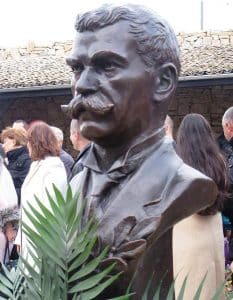
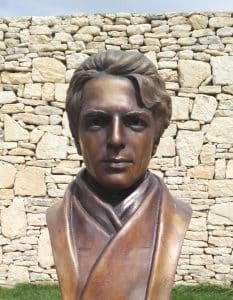
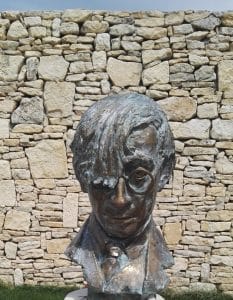
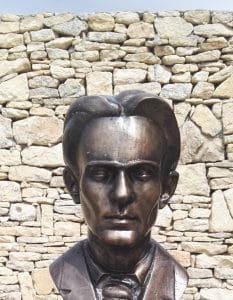
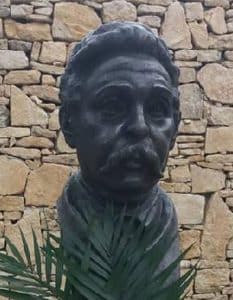
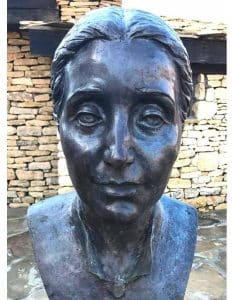
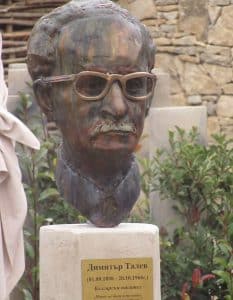
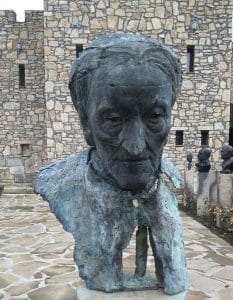
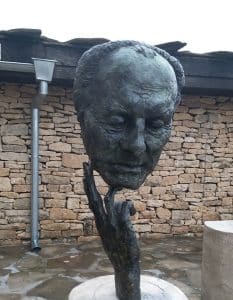
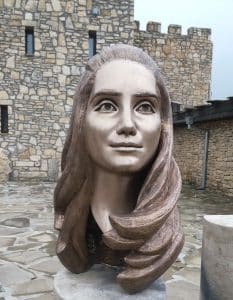
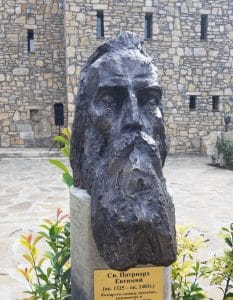
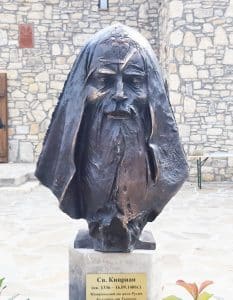
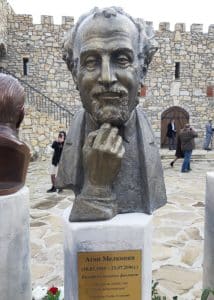
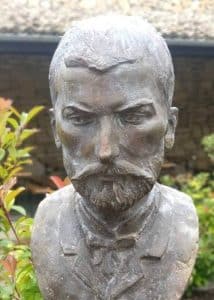
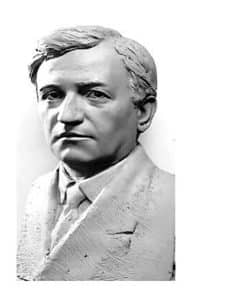
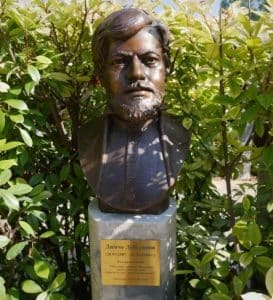
The bust-monument of Dimitar Talev was created by one of Bulgaria’s most internationally acclaimed monumental sculptors, Academician Krum Damyanov. He participated in the creation of the monumental complexes “Founders of the Bulgarian State” in Shumen (1981), “The Asenevtsi” in Veliko Tarnovo (1985), and “The Bells – Banner of Peace” in Sofia (1979).
He is also the creator of “The Defenders” (the Samara Flag) in Stara Zagora, the Clock Tower in Haskovo, the monument to Sophronius of Vratsa in Vratsa, “Crucifixion” in Kyustendil, “Orpheus” in Kardzhali and many other works. Krum Damyanov’s monumental sculptures can also be found in Sofia – including works dedicated to Elin Pelin and Georgi Asparuhov – at Rupite, where he created the cross of the Church of St. Petka, as well as in Germany and Belgium.
His smaller-scale works are held by galleries and private collections in Bulgaria, Austria, Belgium, France, the Netherlands, Norway, the United States and South Korea. He was awarded the Order of Saints Cyril and Methodius, First Class in 2008 and the Order of Stara Planina, First Class in 2016. In 2009, he received the Paisius of Hilendar State Award.
Damyanov was included in the International Biographical Centre’s “Men of Achievement” in Cambridge, United Kingdom (1992), as well as in the American Biographical Institute’s “Five Hundred Leaders of Influence” (1994, 1998, 2003). In 2017, he received the Bulgarian Ministry of Culture’s highest distinction, the “Golden Age” Award, for his exceptional contribution to the development of Bulgarian culture and national identity.