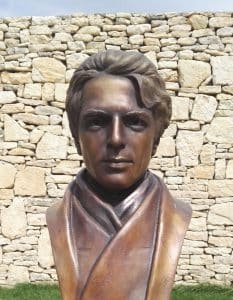
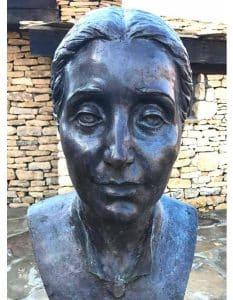
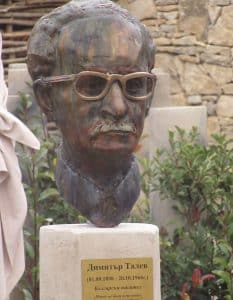
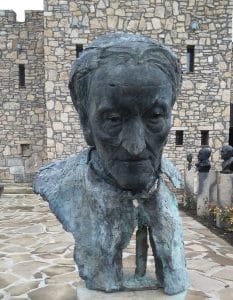
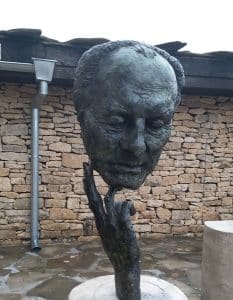
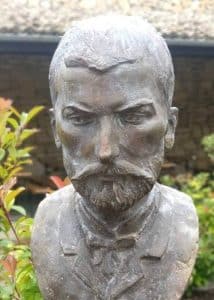
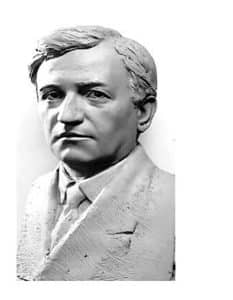
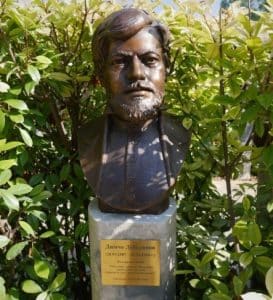
(30.1.1882 – 15.1.1945)

“Oh, never shall perish the People who can forge for themselves the law of life.” These words from the poem “The Incantation of the Word” express the faith in Bulgaria of one of the country’s poets of international stature – Teodor Trayanov, architect, diplomat, Bulgaria’s first chess champion and the first Chairman of the Bulgarian Chess Federation (1931).
Born in Pazardzhik to a judge and a teacher, Trayanov had the opportunity to study in Vienna, one of Europe’s great cultural centres. There he graduated in architecture and came into contact with many of the philosophers and artists associated with German-language modernism at the beginning of the 20th century – Fichte, Husserl, Nietzsche, Rainer Maria Rilke, Arthur Schnitzler, and others.
While still a student, he sent his first literary works from Vienna to Bulgaria, where they were published in various magazines, including “Smyah,” “Hudozhnik,” “Nash Zhivot,” and “Novo Obshtestvo.” During the Balkan Wars (1912–1913), he returned to his homeland to serve as a volunteer in defence of its freedom.
In 1914, he was sent on a diplomatic mission to Vienna, where he remained until 1922. After being recalled by the government of Alexander Tsankov in 1923, he returned to Sofia and devoted himself to literary and publishing activities.
Together with Ivan Radoslavov and Lyudmil Stoyanov, he was one of the editors of the magazine “Hyperion”, the leading forum of Bulgarian Symbolism. Trayanov himself was one of the founders of this literary movement in Bulgaria with his poem “A New Day” (1905).
For seven years, he taught at the school from which he himself had graduated – the First Boys’ High School – and translated works by Shakespeare, Schiller and Heinrich von Kleist.
Regarding his books “Bulgarian Ballads” (1921) and “Earth and Spirit” (1921–1926), his friend and admirer Garegin Nzhdeh, the Armenian general who had defended both his own homeland and Bulgarian lands against Ottoman forces, wrote in a letter to Trayanov:
“If I commanded the Bulgarian army, church and school, I would order every soldier and commander, /…/, every pupil and teacher – every Bulgarian – to carry your ballads upon their breast /…/ Glory to you and to the people who gave birth to you!”
Three women inspired the poet’s muse: Elena Peters of Vienna, who became his wife in 1906; his great love Dora Dyustabanlieva, with whom he shared fourteen devoted years after returning to Bulgaria until her early death – her sister Zheni was Hristo Smirnenski’s fiancée – and Vera Balabanova, who brought new life to his final years as his secretary, friend and companion.
The Austrian writer and essayist Karl Anton, Prince of Rohan, described Trayanov’s significance in these words:
“He is a poet, a bard of European significance and European stature, whose unfamiliar language is the only obstacle on his path to fame… That unfamiliar language, spoken by barely nine million people, which rings and resounds in his poetry like an incantation to the new century!”
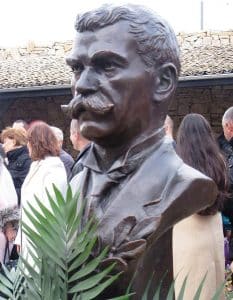
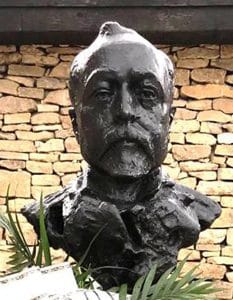
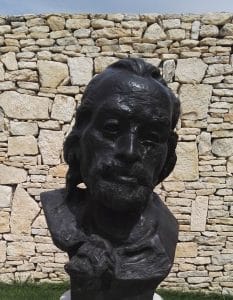
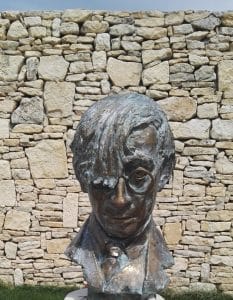
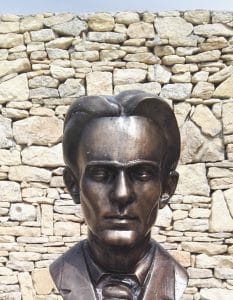
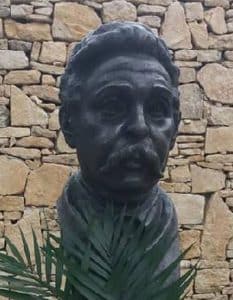
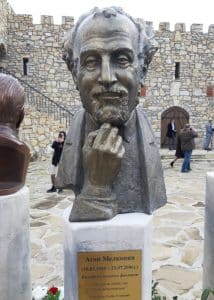
The bust-monument of Teodor Trayanov was created by sculptor Krasimir Angelov. He is also the author of a bas-relief of Vasil Levski in front of the Bulgarian Embassy in Paris, a bust-monument of the Apostle of Freedom in Silistra, the Monument to Freedom in Botevgrad, and other sculptural compositions throughout Bulgaria.
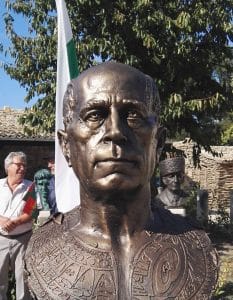
On 11 May 2017, an imposing sculpture of the Bulgarian ruler Tsar Simeon the Great was unveiled at the Tsar Simeon the Great Private School in Sofia. In creating the work, Angelov used Simeon’s personal lead seal, bearing the inscription: “Basileus of the Romans.”