(28.8.1888 – 16.11.1983)

“Our sky is so deep, our stars are so great, and our land is endless, yet all of it fits within my heart!” The poem “Love” by Dora Gabe expresses profound admiration for the beauty and richness of her homeland.
The work of the poet, writer and translator, who lived for almost a century, radiates the warmth and tenderness of the feminine spirit while at the same time expressing the universal human longing for freedom and liberation from social constraints.
The daughter of Petar Gabe, a Russian Jewish immigrant who settled in Dobrich and became a journalist and public figure, Dora Gabe received an unusually high level of education for a woman at the beginning of the 20th century. Born Isidora Peysakh, she first studied natural sciences at Sofia University and later graduated in French philology in Geneva and Grenoble.
Her marriage to one of the most erudite figures of the era, literary historian and philosopher Boyan Penev, opened the doors of the world and its culture to the young woman. Together with her husband and independently as a translator, she visited Poland, Germany, Austria, Great Britain, France and Czechoslovakia, where she presented Bulgarian literature and deepened her knowledge of European culture.
Her dramatic relationship with the poet Peyo Yavorov, who was in love with her and encouraged her poetic efforts, led to the publication of her first poetry collection, “Violets.” She later published her works in the magazines “Misal,” “Zlatorog,” “Zhenski Glas,” and other popular periodicals.
She also established herself as a writer for children. Several generations grew up with her novels, including “Silent Heroes” (1931), novellas such as “We, the Little Ones” (1946), and her poetry.
In her later years, Dora Gabe published several collections of poetry reflecting the transformation of a personality enriched by a lifetime of experience and wisdom: “New Poems,” “Wait, Sun,” “Invisible Eyes,” “Condensed Silence,” “Depths,” and “The World Is a Mystery.”
As a cultural mediator, she became one of the founders of the Bulgarian-Polish Committee in 1922. For many years she served as President of the Bulgarian PEN Club, part of the international organization of writers and journalists. From 1947 to 1950, she served as a cultural adviser at the Bulgarian Embassy in Warsaw. She translated into Bulgarian works by some of the most significant Polish, Czech, French, Greek and Russian authors.
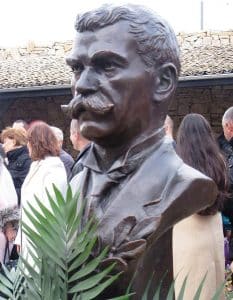
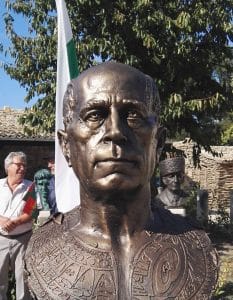
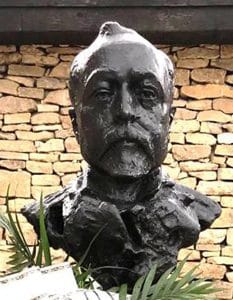
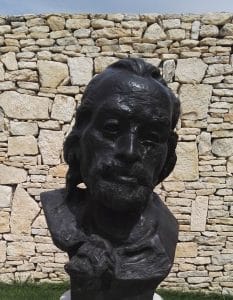
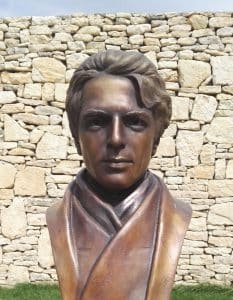
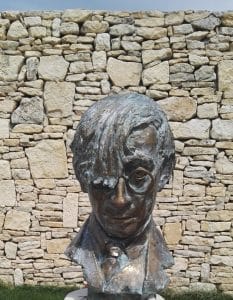
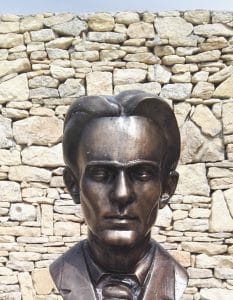
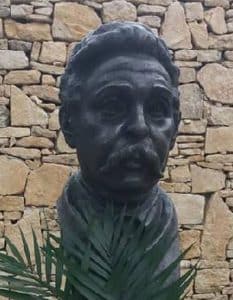
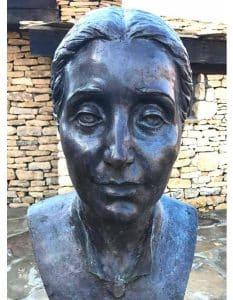
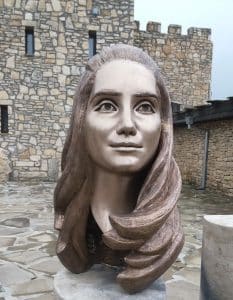
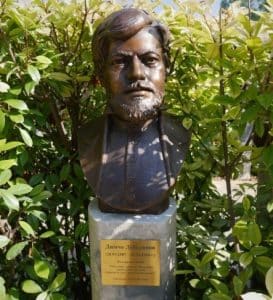
The bust-monument of Dora Gabe was created by sculptor Zoya Lekova. She graduated from the National Academy of Art in 2000, where she studied in the studio of Prof. Krum Damyanov. In 2016, she defended her doctoral dissertation on “metal in monumental sculpture,” examining the work of several of Bulgaria’s most prominent artists.
She currently teaches part-time in the Academy’s Department of Metal. A bust-monument of Academician Kiril Popov created by her is displayed at the Faculty of Mathematics and Informatics of Sofia University. Her first solo exhibition was held in Shumen in 2000 and was followed by participation in national and international exhibitions. In 2005, she received the Audience Award at the Second National Ice Sculpture Symposium and Competition in Bansko.